DOI 10.14209/sbrt.2025.1571137448
Pedro Marcio Raposo Pereira, Amin Hoseini, Samuel Gomes, Felipe Augusto Pereira de Figueiredo, Rausley Adriano Amaral de Souza, Gustavo Fraidenraich, Michel Daoud Yacoub
The emergence of \ac{DL} in wireless communications has revolutionized the design of transceivers, enabling end-to-end learning-based systems such as autoencoders. Unlike traditional communication systems that rely on separately optimized blocks for encoding, modulation, and decoding, an autoencoder jointly optimizes the transmitter and receiver, leading...
Deep learningAutoencoderConvolutional Neural NetworkWireless Communication
DOI 10.14209/sbrt.2025.1571137590
Evandro Cesar Vilas Boas, Rausley Adriano Amaral de Souza, Felipe Augusto Pereira de Figueiredo
This work proposes a fan-shaped beam cavity-backed slot antenna based on epsilon-near-zero (ENZ) medium for millimeter waves. The air-filled metallic cavity is doped by FR4 dielectric slabs enclosed by four metallic rods. The cavity shape is semi-cylindrical and fed by a commercial single waveguide-to-coaxial transition (WR28), exciting a slot at 26.5GHz...
DOI 10.14209/sbrt.2025.1571138471
Rogério Pereira Júnior, Victoria Souto, Richard Demo Souza
In this paper, we evaluate a Wireless Energy Transfer (WET) system assisted by a Simultaneous Transmission and Reflection Reconfigurable Intelligent Surfaces (STAR-RIS) and consider the concept of beamsharing, which allows IoT devices to harvest energy even while others are actively being charged. Then, determining the optimal charging sequence is...
Wireless Energy TransferAnt Colony OptimizationBeamforming
DOI 10.14209/sbrt.2025.1571141712
Marcos Lima Romero, Ricardo Suyama
Data has become a critical asset in the digital economy, yet it remains underutilized by Mobile Network Operators (MNOs), unlike Over-the-Top (OTT) players that lead global market valuations. To move beyond the commoditization of connectivity and deliver greater value to customers, data analytics emerges as a strategic enabler. Using data efficiently is...
NWDAFData AnalyticsMachine Learning5G
DOI 10.14209/sbrt.2025.1571142924
Aline F. G. Sousa, Clebson I. S. Silva, Ronaldo F Zampolo
Estimating performance bounds can improve the comparative analysis of saliency models by exposing their strengths and weaknesses. This paper evaluates two approaches for estimating bounds on immersive videos: Equator Bias and Saliency Sum. For validation, we compare them with outputs from two attention models - Spherical U-Net and DAVE - using three...
Visual attention modelingimmersive videoperformance boundsperformance metrics
DOI 10.14209/sbrt.2025.1571143051
Michel Bernardo de Paiva, Francisco Rafael Marques Lima
The increasing demand for high-capacity wireless communication has led to the investigation of advanced multiple access techniques. Rate Splitting Multiple Access (RSMA) stands out for its interference management capabilities, while Low Earth Orbit (LEO) satellite networks offer global, high-speed coverage. This work explores the integration of RSMA into...
RSMALEO SatellitePrecoderPower Allocation
DOI 10.14209/sbrt.2025.1571143182
João Vítor Macedo De Melo Moreira, Matheus Santos Ferreira, Jefferson Costa Silva
Considering the demands of fifth generation mobile communication system technology (5G), this paper proposes the development of a compact triangular patch antenna with slots, designed to operate in the frequency bands used by this wireless communication system in Brazil. Starting from the initial design equations, the proposed structure was simulated...
DOI 10.14209/sbrt.2025.1571143516
Dayan A. Guimarães, Luiz Gustavo B. Guedes
The Atkinson index detector (AID) was recently developed for cooperative spectrum sensing. It is parameterized by the inequality aversion parameter E, which controls sensitivity to data disparities. However, the original publication where the AID was devised did not explore in detail the influence of E in the spectrum sensing performance. This paper...
DOI 10.14209/sbrt.2025.1571143578
Bruno Matias de Sousa, Valdemir Praxedes da Silva Neto, José Patrocínio da Silva
This article proposes a Defect Ground Structure (DGS) based on the Thue-Morse sequence with a Hairpin-Based sensor optimized for S-band applications. The microwave sensor operates within a frequency range of 2.27 to 2.42 GHz and is constructed on a printed circuit board with a copper foil and FR-4 substrate, with a permittivity of 4.4 and a loss tangent...
Microwave sensorHairpin topologyThue-Morse sequence
DOI 10.14209/sbrt.2025.1571143827
Samuel Costa, Gabriel Fré, André Souza, Alessandro Luz Sr.
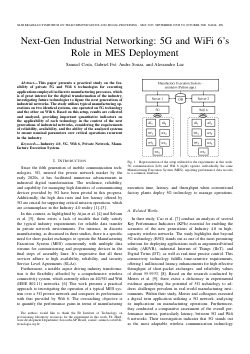
This paper presents a practical study on the feasibility of private 5G and Wifi 6 technologies for executing applications employed in discrete manufacturing processes, which is of great interest for the digital transformation of the industry, investigating future technologies to figure the next generations of industrial networks. The study utilizes...
Industry 4.05GWifi 6Private Network