DOI 10.14209/sbrt.2019.1570558795
Dimitri L. O. Silva, Jeferson R Cotrim, João H. Kleinschmidt
O presente trabalho avaliou o desempenho de uma rede LoRaWAN na conjuntura de Internet das Coisas para um Campus Inteligente. Os testes foram realizados no campus Santo André da Universidade Federal do ABC, onde foram aferidas a taxa de perda de pacotes, a potência do sinal e configurações de transmissão. Os resultados obtidos mostraram que, apesar de...
DOI 10.14209/sbrt.2019.1570558799
Dayrene Frometa, Rodrigo C. de Lamare, Ewerton Madruga
LoRaWAN and RS-LoRa are two of the most recent MAC layer proposals for Internet of Things (IoT). In this paper, we extend the performance evaluation of these protocols to mobile scenarios, using relevant metrics as the average Packet Error Ratio (PER) and the average network delay. Different scenarios are evaluated by varying the number of gateways,...
DOI 10.14209/sbrt.2019.1570558808
Rafael R Pertum, Eduardo V Kuhn
Este artigo trata da implementação e da avaliação de desempenho de um sistema de cancelamento adaptativo de ruído, operando com relevantes algoritmos adaptativos da literatura [isto é, o NLMS (normalized least-mean-square) e três diferentes VSS-NLMS (variable step-size NLMS)]. Tal implementação é realizada aqui em linguagem C utilizando a placa de...
DOI 10.14209/sbrt.2019.1570558812
Diogo Alfieri Palma, Leonardo Tomazeli Duarte
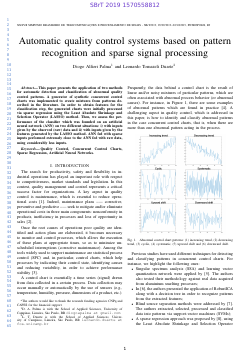
This paper presents the application of two methods for automatic detection and classification of abnormal quality control patterns. A generator of synthetic concurrent control charts was implemented to create mixtures from patterns described in the literature. In order to obtain features for the classification step, the generated charts were initially...
DOI 10.14209/sbrt.2019.1570558820
Camila Novaes Silva, Cleverson Nahum, Igor Trindade, Daniel Cederholm, Gyanesh Patra, Aldebaro Klautau
Virtualization is a key feature in Cloud Radio Access Network (C-RAN). It can help to save costs since it allows the use of virtualized base stations instead of physically deployment in different areas. However, the creation and management of virtual base stations pools is not trivial and introduces new challenges to C-RAN deployment. This paper reports...
DOI 10.14209/sbrt.2019.1570558825
Ricardo Marques Ribeiro, T. A. M. G. Freitas
This paper describes a simple opto-acoustic detector based on a fibre-optic modalmetric device in reflective structure, primarily thought for digital acoustic communication. A single-mode fibre was spliced with a sensitive multimode fibre (s-MMF) strand leading to a modalmetric device, which was probed with 1550 nm wavelength. A non-linear increase of...
DOI 10.14209/sbrt.2019.1570558828
Mauro L Brandão, Rafael Ferrari, Renato R Lopes
A exploração de hidrocarbonetos depende de imagens de alta resolução da subsuperfície da Terra, e essas podem ser adquiridas pelo método sísmico. Uma etapa importante do pré-processamento sísmico é a obtenção do modelo de velocidades. Uma maneira típica de se construir o modelo de velocidades é pela análise de velocidades baseada em normal-moveout (NMO),...
Picking automático de velocidadesAnálise de velocidadesTransformada de Radon hiperbólica
DOI 10.14209/sbrt.2019.1570558840
Gabriel S Chaves, Markus V. S. Lima, Tadeu Ferreira
O algoritmo proportionate normalized least-mean-square (PNLMS) e suas variantes são frequentemente usados na literatura para atacar problemas relacionados à estimação/identificação de sistemas esparsos. O objetivo deste trabalho é mostrar que existem vários cenários esparsos em que o desempenho do algoritmo PNLMS é inferior até mesmo ao do algoritmo...
DOI 10.14209/sbrt.2019.1570558842
Andresso da Silva, Francisco M. Assis, Marlo Santos
This paper presents an architecture for the Mastrovito multiplier using linear threshold circuits. Optimal irreducible polynomials are determined for the construction of the Mastrovito multiplier in finite field GF(2^m), for 1<m<17. The proposed architecture provides minor theoretical spatial complexity. However, when using the optimal irreducible...
DOI 10.14209/sbrt.2019.1570558844
Mateus M da Rosa, Daniel G Silva
Recently proposed ICA over finite alphabets algorithms are analysed in this work, whether they are under the linear paradigm i.e. finite fields, whether they comprise a permutation based model, namely the QICA algorithm. Numerical experiments are performed for the classical application of BSS, and for a non-linearly-generated dataset. Despite the QICA...