DOI 10.14209/sbrt.2026.1571299883
Lais Sousa da Rocha, Lívia Amaral Lopes, Aline F. G. Sousa
Wildfire detection through remote sensing is essential for reducing environmental impacts. This work compares the ResNet50, VGG19, and MobileNetV3 architectures for wildfire detection using Landsat-8 and Landsat-9 imagery, incorporating Green AI metrics. ResNet50 achieved the best predictive performance, reaching 85% accuracy, an AUC of 0.95, and zero...
forest firesconvolutional neural networkssatellite imageryGreen AI
DOI 10.14209/sbrt.2026.1571299884
Adrion Andrei Rosanelli, Carlos Henrique Barriquello, Gustavo Denardin
LoRa is a relevant communication technology that can be analyzed and improved by tools like Digital Twins and simulators. For these tools to be used effectively, it is desirable that they can operate on a large scale. This work aimed to implement a LoRa physical-layer simulation using TensorFlow and Sionna, exploring the parallel GPU simulation and the...
LoRaSimulationGPU-ParallelDigital Twin
DOI 10.14209/sbrt.2026.1571299886
Karen dos Anjos Arcoverde, Vinicius Nunes Henrique Silva, Tadeu N Ferreira, Roberto B. Di Renna
The next-generation of mobile communications (6G) introduces the concept of cell-free (CF) architectures, where multiple distributed access points (APs) cooperate to jointly serve users, while still facing several challenges to be addressed. This paper evaluates AP congestion during high-density events and user equipment (UE) association by APs in uplink...
6GCell-free massive MIMOFederated reinforcement learningResource allocation
DOI 10.14209/sbrt.2026.1571299890
Raul Victor de Oliveira Paiva, Alla Manina, Tarcisio Ferreira Maciel, Martin Haardt
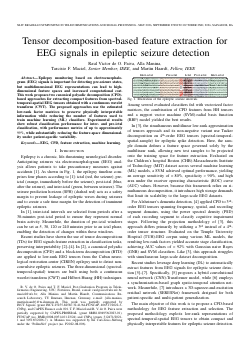
Epilepsy monitoring based on electroencephalogram (EEG) signals is important for detecting pre-seizure states, but multidimensional EEG representations can lead to high-dimensional feature spaces and increased computational cost. This work proposes two canonical polyadic decomposition (CPD)-based approaches for extracting compact features from...
EEGCPDfeature extractionmachine learning
DOI 10.14209/sbrt.2026.1571299893
Matheus Figueiredo, Rosiane Brito, Frederico da Silva Pinagé, Waldir Silva, Celso Barbosa Carvalho
With the increasing use of connected devices in Internet of Things (IoT) networks, concerns regarding cybersecurity have also grown. This work presents a machine learning-based methodology for cyberattack detection using aggregated network flow data. The CICIoT2023 dataset was employed to evaluate the proposed approach. The results demonstrated effective...
DOI 10.14209/sbrt.2026.1571299894
Melryllin Genniani de Oliveira Sousa, Jean Carlos de Souza Ferreira, Fazal-E Asim
This paper proposes structured channel-parameter estimators for reconfigurable intelligent surface (RIS)-assisted multiple-input multiple-output (MIMO) systems employing uniform rectangular arrays under line-of-sight propagation. By exploiting the Kronecker and multilinear structures of the cascaded channel, we introduce the Successive Kronecker...
reconfigurable intelligent surface (RIS)channel parameter estimationKronecker factorization and tensor decompositionuniform rectangular array (URA)
DOI 10.14209/sbrt.2026.1571299899
Jaidan Lessa Oliveira, Alex Santos, Karcius Assis
Este artigo apresenta uma plataforma de simulação para o planejamento de redes de Distribuição de Chaves Quânticas (QKD) sobre infraestruturas ópticas WDM. O software integra visualização de topologias, avaliação de desempenho e heurísticas de otimização para analisar alocação de recursos, posicionamento de nós confiáveis e uso espectral sob restrições...
Redes QuânticasDistribuição de Chaves Quânticas (QKD)Heurísticas
DOI 10.14209/sbrt.2026.1571299901
Neuton Severo de Farias Neto, Renato Machado, Leandro Guimarães Figueroa Pralon, Bruno Pompeo
Rain clutter degrades surveillance radar perfor- mance by masking weak targets and increasing false alarms. Classical clutter models are formulated in the linear-amplitude domain, yet the large dynamic range of rain returns motivates a logarithmic transformation for more tractable statistical characterization. This paper analyzes the statistical...
Rain clutterS-band surveillance radarLog- domain analysis
DOI 10.14209/sbrt.2026.1571299902
Jeison Alfredo Magallanes Poma, Jonathan Aguiar Soares, Icaro Menezes Saraiva de Freitas, Christian Esteve Rothenberg, Dalton Arantes, Marco Roberto Cavallari
Embedded machine learning enables latency sensitive signal processing at the network edge, but neural receivers on small FPGA platforms require careful quantization and hardware co-design. This paper presents a quantized convolutional neural network (CNN) equalizer for a real-valued 2 x 2 BPSK MIMO channel with finite memory, implemented on a Digilent...
Edge Machine LearningMIMO EqualizationQuantized Neural NetworksFPGA
DOI 10.14209/sbrt.2026.1571299909
Lisandro Lovisolo, Gabryel Medeiros de Oliveira, Helio Nascimento Cunha Neto, Leonardo Rey Vega, Guilherme Mota
Deep neural networks (DNN) achieve high performance across many tasks. They often require extensive parameter sets and computationally intensive weight representations. The memory footprint, storage demand, and arithmetic complexity directly affect the practical deployment of DNN models, especially in resource-constrained settings. We investigate...
Deep learningCompressionSopots