DOI 10.14209/sbrt.2017.76
Paulo Ricardo Branco da Silva, Danilo Silva
We propose linear-time encoding and decoding al-
gorithms for multilevel LDPC lattices based on Construction D 0 .
Moreover, a generalization of Construction D 0 is proposed
which leads to a new class of multilevel lattices. Based on this
construction, two-level LDPC lattices are designed that achieve
performance comparable to that of polar lattices...
Construction D 0latticesLDPC codesmultilevel codesmultistage decoding
DOI 10.14209/sbrt.2017.77
M. V. M. Bassi, C. H. M. de Lima, A. A. Ferreira
This paper addresses spectrum sensing and sharing
strategies for machine type communication in the cognitive net-
works. We assess how such solutions preserve the transmissions of
the primary nodes, as well as their impact on the performance of
the underlay secondary network. The system-level performance
is evaluated by means of computer simulations...
MTCIEEE 802.11self-organizationspectrum sensingcognitive radio
DOI 10.14209/sbrt.2017.78
Ana Carolina de Oliveira Christófaro, Marcelo Menezes de Carvalho, Daniel Guerreiro e Silva
Software Defined Network is a traffic engineering
solution with an increasing interest by industry, which raises
issues such as the use of multiple controllers. Considering that
the positioning of controllers within a given topogoly constitutes a
multiobjective optimization problem in order to satisfy certain
performance metrics, this work presents...
SDNNSGA-IIPSA
DOI 10.14209/sbrt.2017.79
Lukas M. Torquato, André Felipe Monteiro, Felipe da Rocha Henriques
Elderly, patients who suffered from strokes,
neurological, articular, cardiovascular illness and other diseases
like muscular dystrophies are examples of cases which affects an
individual’s mobility. Thus, remote monitoring and care is an
effective way to avoid the worsening of these sequels. With this
question in mind, the development of a tool for...
Fall detectionAndroidSmartphone
DOI 10.14209/sbrt.2017.80
Guilherme Fernandes de Souza Miguel, Carlos Alexandre Gouvea da Silva, Carlos Marcelo Pedroso, Eduardo
Parente Ribeiro
The mobile devices technological evolution and
the increased availability of IP (Internet Protocol) networks,
created new opportunities for multimedia content distribution
over Internet. Real-time applications require high quality service
and are not tolerant to mean packet delay above 200ms, delay
variations and throughtput reduction. The use the...
Multihomingmultipathvideo streaming
DOI 10.14209/sbrt.2017.81
Rafaella D. Oliveira, Michele C. Zanon, Leonardo Campos, Ricardo M. Ribeiro, Vinícius N. H. Silva
This work of Scientific Initiation describes the
development of demultiplexers (DEMUXs) for wavelength-
division multiplexing (WDM) over PMMA (poly-methyl-
metacrylate) plastic optical fibre links using visible laser diodes.
The DEMUXs were built from the combination of POF-splitters
with gel plastic filters. The latter operates as high-pass or...
Data communication networksPlastic optical fibresPlastic filmsWDMOptical filters
DOI 10.14209/sbrt.2017.82
Weskley V. F. Mauricio, F. Rafael M. Lima, Tarcı́sio F. Maciel, Francisco R. P. Cavalcanti
In this article we revisit the Radio Resource Allo-
cation (RRA) problem of maximizing the ratio from the total
data rate and the total utilized power subject to the QoS
satisfaction (PMEE). It was previously studied in [1] and one
optimal solution was obtained. However, that solution has a
very elevated computational cost. In this article, we will...
Radio Resource AllocationEnergy Efficiency and Quality of Service
DOI 10.14209/sbrt.2017.2
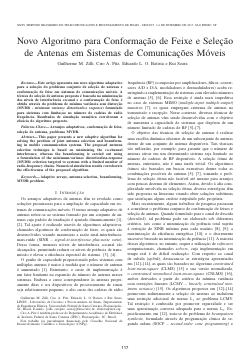
Guilherme M. Zilli, Ciro A. Pitz, Eduardo L. O. Batista, Rui Seara
This paper presents a new adaptive algorithm for
solving the problem of joint antenna selection and beamform-
ing in mobile communication systems. The proposed antenna
selection technique is based on minimizing the co-channel
interference, whereas the beamforming is carried out using
a formulation of the minimum-variance...
Adaptive arraysantenna selectionbeamformingMVDR problem
DOI 10.14209/sbrt.2017.84
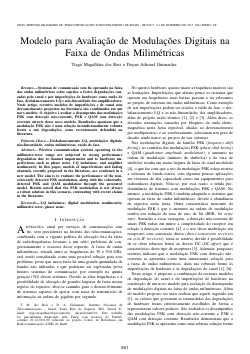
Tiago Magalhães dos Reis, Dayan Adionel Guimarães
Sistemas de comunicação sem fio operando na faixa das ondas milimétricas estão sujeitos a fortes degradações causadas pelo canal e por imperfeições de hardware como ruído de
fase, desbalanceamento I-Q e não-linearidade dos amplificadores. Neste artigo, recentes modelos de imperfeições e de canal com desvanecimento propostos na literatura são combinados...
Desbalanceamento I-Qmodulações digitaisnão-linearidadeondas milimétricasruído de fase
DOI 10.14209/sbrt.2017.85
Pedro Ivo da Cruz, Ricardo Suyama, Murilo Bellezoni Loiola
The wireless physical layer security can assist traditional encryption mechanisms by generating the keys, for instance. However, some techniques allow hiding information directly in the physical layer, such as performing precoding at the legitimate user information about the channel, such as the received signal strength or the phase response. Most works...
wireless physical-layer securitychannel estimationprecodingblind equalization